
From ESS News
Lithium-ion battery energy storage system (BESS) imports into Pakistan reached 4.6 GWh in 2025, a 220% year-on-year increase, according to a new report from Islamabad-based think tank Renewables First.
The report, From Solar Panels to Storage: Pakistan’s Battery Boom Begins, says that battery storage is beginning to follow the growth trajectory of rooftop solar in Pakistan as it moves from a niche add-on to a structural necessity due to a convergence of factors including soaring electricity prices, increasing solarized households, falling battery costs globally and net billing reforms.
“As rooftop solar adoption accelerates, battery storage is emerging as the logical next step in Pakistan’s energy transition story, letting consumers capture surplus daytime generation and deploy it during evening peak-tariff hours,” the report explains. “With net billing reducing the value of exports to the grid, storing surplus solar energy is becoming increasingly attractive, setting the stage for a battery rush.”
Total imports of lithium-ion batteries into Pakistan since 2018 reached 7.6 GWh by the end of the last year. Annual imports stood between 0.1 GWh and 0.5 GWh from 2018 to 2023 before the market began to take off in 2024, with 1.4 GWh of imports, before last year’s surge to 4.6 GWh.
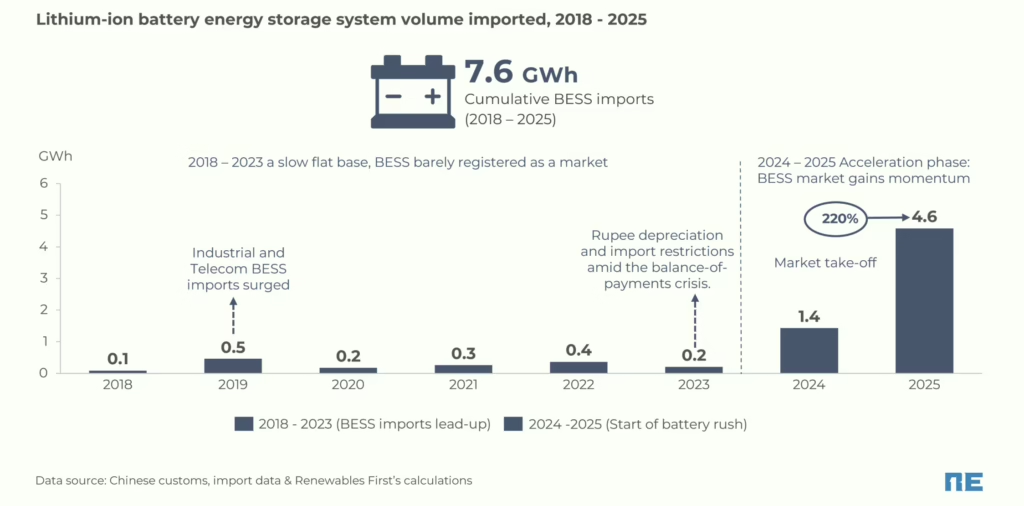
Huma Naveed, Senior Associate – Data Scientist at Renewables First, told ESS News that the same pattern seems to be holding in the first half of 2026, with imports running particularly high in March and April this year.
“Nearly 60% of everything imported into the country since 2018 arrived in just the last twelve months, which tells you this is not a gradual build-up; it is a market that switched on almost overnight,” Naveed added.
Figures from the report state residential BESS imports reached 3.1 GWh by the end of 2025, with 2.44 GWh arriving last year alone. Around 282,000, or 4%, of solarized households in Pakistan now have BESS installed at home. Renewables First predicts that as BESS adoption in Pakistan accelerates, the residential segment will “remain the cornerstone of Pakistan’s distributed energy transition.”
Systems between 5 kWh and 10 kWh in size currently dominate Pakistan’s residential BESS market, accounting for 1.94 GWh of imports to date. The report says these systems strike the best balance between affordability, backup duration and household energy needs.
Commercial BESS imports into Pakistan reached 1.0 GWh by the end of 2025, which the report attributes to the growing energy needs of small- to medium-sized enterprises and solar integration across commercial facilities, while industrial BESS imports reached 2.0 GWh by the end of 2025, driven by high-load energy optimization needs, process continuity requirements and growing solar adoption across industrial facilities.
The remaining BESS imports consist of telecom BESS, which reached 1.4 GWh by the end of 2025. Renewables First says this market is driven by tower backup needs, off-grid connectivity and the gradual displacement of diesel generators across base station networks.
The report also notes the global decline in battery prices, which have fallen around 75% in the last decade, are forecast to fall further through to 2027. It predicts that if price trajectories hold, BESS imports are likely to accelerate in Pakistan. “Sustained cost declines would drive wider battery uptake across residential, commercial and industrial segments, extending the momentum already visible in the data,” the report says.
Muhammad Mustafa Amjad, Program Director at Renewables First, told ESS News that Pakistan has already lived through one consumer-led energy transition, where households stopped waiting on the grid and rewired the country themselves, with policy steadily catching up alongside them.
“Batteries are now on the same path, but only faster,” he added. “The opportunity this time is to move with the market from the start: plan for storage early and lead the next phase together, so that equity and inclusion is built into the design rather than bolted on later.”
Reports on Pakistan’s growing storage market follow calls for the country to “declare a battery emergency” and quickly deploy energy storage to support its continually-growing solar market. Pakistan had deployed an estimated 51 GW of solar as of March 2026, according to additional reporting from Renewables First, with solar module imports reaching 54 GW by the end of the same month.
The post Pakistan imports 4.6 GWh of BESS in 2025 appeared first on pv magazine Global.