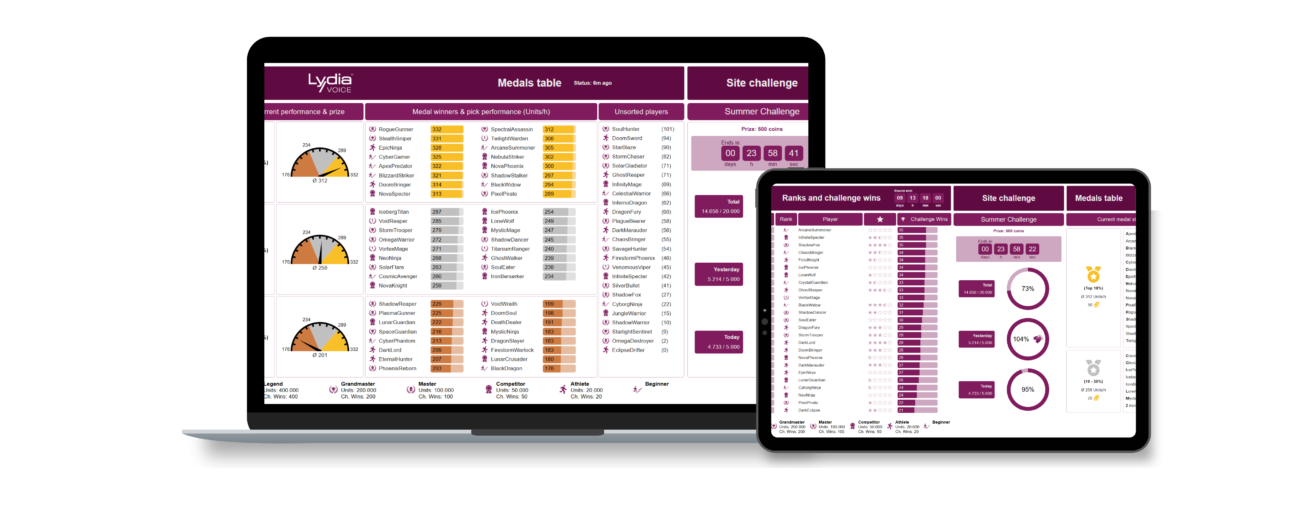
For years, warehouse productivity has been driven primarily by technology: automation, robotics, warehouse management systems, and artificial intelligence. While these tools are essential, they overlook a key reality: logistics remains a labour-intensive environment. In many processes – especially picking – people make decisions, execute tasks, and ensure quality every day.
This is where warehouse gamification becomes relevant. Rather than a novelty, it provides a structured way to connect motivation, focus, and performance within daily operations. Motivation, attention, and purpose directly influence outcomes, yet many systems still optimise workflows without offering meaningful feedback to employees. Gamification addresses this gap by embedding recognition and progress into the workflow itself.
Invisible Nature of Daily Work
Warehouse work is highly standardised. Processes are optimized for efficiency, leaving little room for deviation. While this ensures stability, it also creates invisibility: strong performance often goes unnoticed in real time. Feedback is typically delayed and indirect, delivered through KPIs or reports rather than during the activity itself.
As a result, employees often receive attention only when errors occur. Motivation is treated as a personal trait rather than something shaped by system design. In times of labour shortages and high turnover, this becomes a structural issue. When work feels repetitive and unrecognized, employees are more likely to disengage or leave.
Research consistently shows that motivation, focus, and perceived meaning impact performance and quality. Yet many systems remain silent – they measure and control but fail to communicate.
“Motivation does not arise from incentives alone. It develops when people see progress and feel recognised,” says Tim Just (pictured, below), CEO of LYDIA Voice at EPG.
“Two factors are crucial: context and timing. Feedback must be directly linked to the activity and delivered at the right moment. If it comes too late, it loses relevance. If it interrupts the workflow, it becomes counterproductive. Many gamification approaches fail because they operate outside the workflow. Extra screens or disconnected ‘game layers’ may create short-term interest but do not improve the work experience itself.”
Gamification as a Feedback Structure
Effective warehouse gamification is not about games but about structured feedback. It makes progress visible, provides orientation, and integrates recognition into daily tasks. Elements like coins, levels, or challenges are not the goal – they translate performance into tangible signals. For this to work, gamification must not add complexity. It should require no extra actions and must integrate seamlessly into existing processes.
Integration Matters
The effectiveness of gamification depends largely on technical integration. Systems must understand operational context – distinguishing between active work, travel time, and phases of concentration.
“Voice-based systems offer a strong foundation because they are already embedded in workflows”, adds Just. “When gamification is integrated into these systems, feedback can be delivered naturally, for example during walking phases. This avoids distractions while maintaining focus on the task.”
Visibility Without Harmful Comparison
Performance visibility must be handled carefully. Public rankings and constant comparisons can demotivate, especially in diverse teams. Sustainable motivation comes from making individual progress visible without exposing employees to pressure.
Mechanics such as personal levels, badges, or team challenges support this approach. Team-based goals strengthen collaboration and create a shared sense of purpose rather than competition.
Evidence from Research and Practice
Studies on intrinsic motivation highlight three key drivers: visible progress, immediate feedback, and a sense of competence. Warehouse gamification supports these when integrated closely with processes. Practical implementations confirm this: when gamification is part of the system rather than an add-on, it becomes accepted and naturally used. Productivity improvements emerge as a byproduct of better engagement.
Motivation as a System Component
The central insight is that motivation is not a ‘soft factor.’ It is a measurable and designable element of warehouse operations. Properly implemented gamification creates a system language that acknowledges effort, visualizes progress, and supports long-term performance.
As companies seek to increase productivity without adding complexity, motivation plays a larger role than often assumed. Warehouse gamification can contribute significantly when tightly integrated into workflows. The key is not the game itself, but how feedback, progress, and shared goals become part of daily execution.
Please note:
This action will also remove this member from your connections and send a report to the site admin.
Please allow a few minutes for this process to complete.