
Perovskite solar technology could generate approximately INR 74,000 crore ($7.92 billion) in domestic value addition in India over the next 15 years, creating opportunities for Indian companies to develop proprietary materials, manufacturing processes and intellectual property (IP), according to a new study by the Indian Solar Manufacturers Association (ISMA) and P3C Technology and Solution.
The study, titled “Perovskite Solar: India’s Atmanirbharta Opportunity in Next Generation PV,” highlights the potential of perovskite technology to reduce import dependence, cut manufacturing costs and foster domestic innovation. It outlines how the technology could help India move beyond conventional crystalline silicon manufacturing and establish a foothold in advanced solar technologies.
India has expanded its domestic solar cell manufacturing capacity and is developing ingot and wafer production facilities under the Production Linked Incentive (PLI) scheme. However, the country remains heavily dependent on imported polysilicon, wafers and manufacturing equipment.
According to the study, perovskite technology could help address these gaps in India’s solar manufacturing supply chain. Unlike conventional crystalline silicon technology, perovskite solar cell manufacturing can bypass the polysilicon, ingot and wafer production stages, where India’s import dependence is particularly high. This could offer an alternative route to expanding domestic manufacturing while reducing reliance on imported upstream components.
The study also points to potential cost advantages, estimating that capital expenditure for perovskite manufacturing facilities could be 70% to 80% lower than for conventional crystalline silicon production lines.
It further suggests that lower temperature-related performance losses could increase the capacity utilization factor (CUF) from around 20% to 25% and reduce the levelized cost of energy (LCOE) by 30% to 40%. However, these projections remain subject to validation through long-term field performance data.
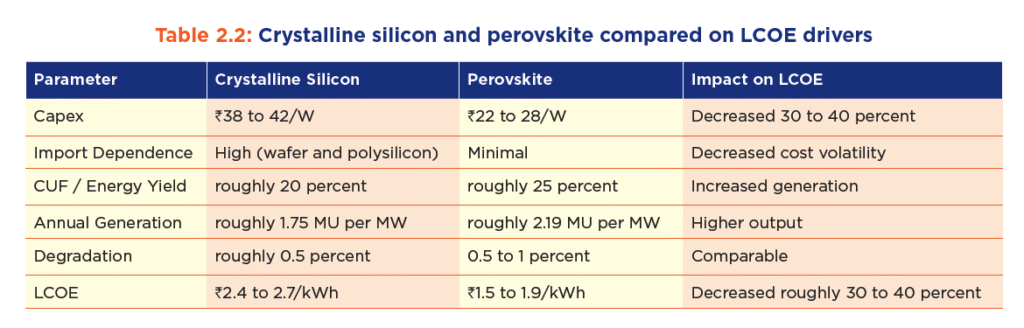
The study estimates that capex for perovskite solar manufacturing could range from INR 22 ($0.24) to INR 28 per watt, compared with INR 38 to INR 42 per watt for crystalline silicon. It also projects higher energy yields for perovskite modules, with annual generation estimated at 2.19 million units per MW, compared with 1.75 million units per MW for crystalline silicon.
The capacity utilization factor (CUF) could increase from around 20% to 25%, while the levelized cost of energy (LCOE) could fall from INR 2.4–2.7/kWh for crystalline silicon to INR 1.5–1.9/kWh for perovskite, representing a reduction of approximately 30% to 40%. However, the study estimates annual degradation of 0.5% to 1% for perovskite modules, compared with around 0.5% for crystalline silicon.
The study recommends a phased approach to technology adoption, starting with single-junction perovskite solar cells, followed by silicon-perovskite tandem cells based on India’s existing tunnel oxide passivated contact (TOPCon) manufacturing infrastructure. This approach could allow domestic manufacturers to leverage existing investments while gradually building capabilities in advanced PV technologies.
To support the transition, the study calls for policy and regulatory measures, including a provisional two-tier classification under the Approved List of Models and Manufacturers (ALMM), with clearly defined stability milestones. It also recommends dedicated research and development (R&D) and pilot project funding through the Ministry of New and Renewable Energy (MNRE) and the Anusandhan National Research Foundation (ANRF), alongside independent techno-economic assessments of commercial viability.
“India’s solar manufacturers have made significant investments in backward integration across cells, wafers and ingots. Perovskite is a promising next step that builds on this foundation. ISMA looks forward to working with the Government and industry on an enabling pathway for next-generation solar technologies,” said Amit Manohar, secretary general of ISMA.
“P3C is developing its own absorber chemistry, assembly line and intellectual property in India. Our modules are undergoing reliability testing at NISE, and our priority is to build the field data that makes this technology bankable. We are glad to work with ISMA to take this conversation to manufacturers and policymakers,” said Sooraj Kumar, co-founder and CEO of P3C Technology and Solutions.
The study concludes that establishing a domestic perovskite manufacturing ecosystem will require sustained investment in research, technology validation, industry participation and policy support. Such efforts could help India expand its role beyond solar manufacturing and deployment to the development and ownership of next-generation PV technologies.
The post Perovskite solar manufacturing could generate $7.92 billion in domestic value addition over 15 years in India appeared first on pv magazine Global.