
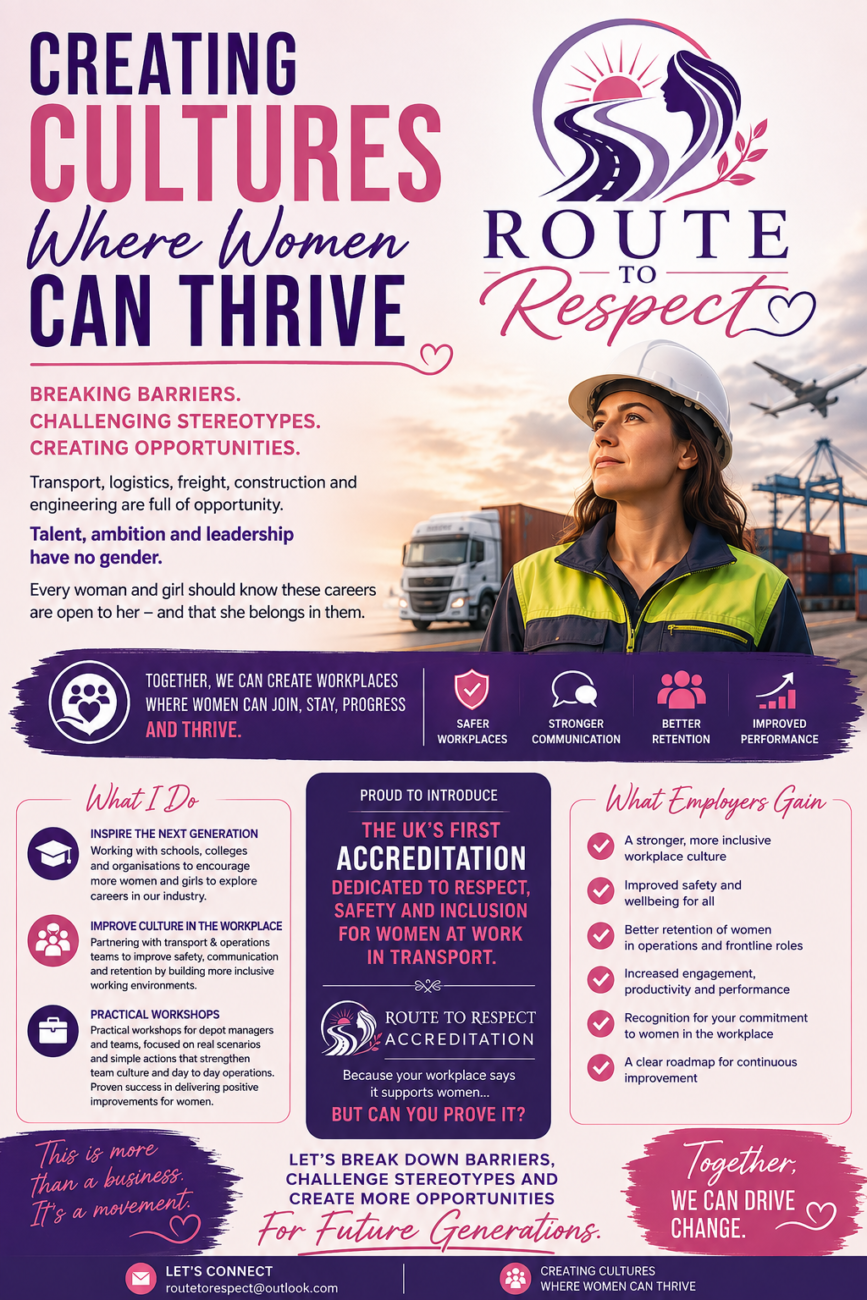
Breaking barriers, challenging stereotypes and creating workplaces where women can thrive are all key, writes Claire McKinlay of Route to Respect.
For generations, industries such as transport, logistics, freight, construction and engineering have been described as male-dominated. It is time to challenge not only that description, but the culture and perceptions that have allowed it to remain true for so long.
Talent has no gender. Ambition has no gender. Leadership has no gender. Every woman and young girl should know that these industries are open to her. Whether her ambition is to become an engineer, driver, operations manager, technician, logistics professional or future industry leader, she should feel that she has every right to take her place.
Throughout my career, I have seen first-hand the incredible opportunities these sectors can offer. I have also seen some of the barriers women can face when entering and progressing within traditionally male-dominated working environments. That experience became one of the driving forces behind Route to Respect.
Inspiring the Next Generation
One of my greatest passions is encouraging more women and girls to explore careers they may never previously have considered.
Young people are often asked at a very early age what they want to do with the rest of their lives. Yet how can they make informed choices if they are unaware of the opportunities available to them?
We need greater visibility. We need women already working within these industries to share their experiences, and we need young women to see that careers in transport, logistics, construction, freight and engineering are not simply ‘jobs for men.’ Sometimes, seeing someone who has already walked that road can be enough to make another young woman believe that she can walk it too.
But attracting women into these industries is only part of the challenge. We also need to create workplaces where they want to stay.
Recruitment Is Only the Beginning
Increasing the number of women entering transport and operational environments is important, but recruitment statistics alone do not create inclusion. What happens after a woman joins the organisation? Does she feel safe, respected? Is her voice heard? Does she have appropriate welfare facilities and PPE? Can she see opportunities to progress? And, perhaps most importantly, does the culture make her want to stay?
These are the conversations organisations need to be having if we genuinely want to improve female representation and retention.
Through Route to Respect, I work with transport and operational teams to improve safety, communication, inclusion and retention, with a particular focus on women working in operational and frontline roles.
Turning Conversation Into Action
My practical workplace workshops are designed for depot managers, frontline leaders and their teams. Rather than relying solely on policies and presentations, the sessions focus on real workplace scenarios and practical actions that can strengthen culture and improve day-to-day operations. I have seen the impact that this approach can have.
In my previous leadership role, focusing on the experiences of women and making practical improvements within the workplace delivered positive change. It demonstrated something important to me: improving workplace culture does not always require enormous interventions. Sometimes it begins with listening. Sometimes it is better communication. Sometimes it is recognising a problem that has simply become accepted as ‘the way things are.’ Small changes, when supported by committed leadership, can create significant improvements.
It’s about creating a workplace that makes women want to walk through it — and giving them every reason to stay.
The post Driving Change: Respect for Women in Transport appeared first on Logistics Business.