
In 2024, Spanish startup FutureVoltaics, a spinoff of the Spanish National Research Council (CSIC), announced he launch of VectHor, a pre-assembled photovoltaic solution consisting of a vertically mounted, landscape-oriented bifacial solar module combined with specular reflectors made of polished, textured metal featuring a proprietary pattern.
The company has now released initial operational results from the largest pilot plant deployed to date using VectHor technology, which is designed to increase irradiance capture and shift part of solar generation toward periods with higher electricity market value.
Developed in collaboration with the Bilbao-Bizkaia Water Consortium (CABB), the installation began operating on Jan. 30, 2026, on the rooftop of a wastewater treatment facility in Lemoiz, Biscay, northern Spain. The pilot plant comprises 144 VectHor5 units with a total installed capacity of 25.2 kW, as well as four south-facing reference units installed at a fixed 10-degree tilt angle, with a combined capacity of 0.7 kW. The benchmark system is being used to compare the performance of the two configurations under the same operating conditions.
The plant is equipped with a Huawei SUN2000-25KTL-M5 inverter and uses Huawei SUN2000-600W-P optimizers on selected modules to monitor generation across different sections of the installation.
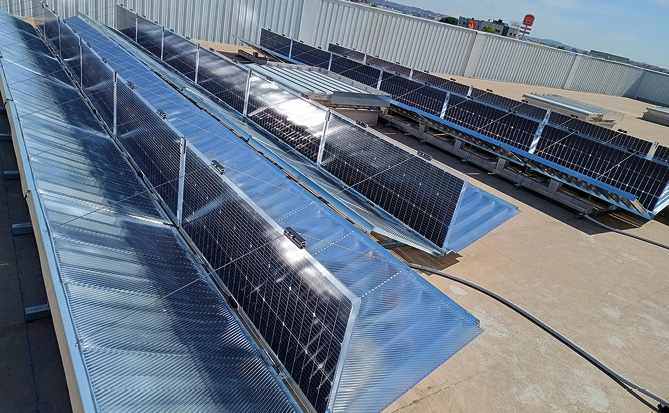
FutureVoltaics told pv magazine that, after five months of operation, the VectHor system achieved a specific yield 51.4% higher than that of the conventional reference installation when normalized by installed kW. According to the company, the VectHor generation profile remained above that of the fixed-tilt system throughout the analyzed period.
Extended production profile
FutureVoltaics said one of the main characteristics of the system is its daily generation profile. Unlike the typical output curve of conventional fixed-tilt PV systems, VectHor maintains generation from early morning until late afternoon, with less pronounced midday variation.
According to the company, this extended generation window allows a greater share of electricity production to occur during periods of higher demand, creating a time-shifting effect similar to energy storage, although without the use of batteries.
A comparison between the system’s generation profile and wholesale electricity prices from the Spanish market operator OMIE indicates that the additional output coincides with periods when electricity prices are typically higher, due to lower solar availability and increased demand.
FutureVoltaics said this translates into higher economic returns. By combining generation data from the first five months of operation with electricity market prices, the company estimates that the VectHor system delivered a 73.6% higher economic return than the conventional PV benchmark installation.
Validation of the VectHor5 platform
The pilot project represents the first operational validation of the latest VectHor5 version, which incorporates several improvements compared with previous iterations.
The installation site, located a few meters from the sea in Armintza Bay, has also provided an opportunity to assess the system’s performance under challenging environmental conditions, including marine corrosion and strong winds. FutureVoltaics said the results confirm the system’s durability under real-world operating conditions, following previous controlled testing.
The data collected during the initial months of operation has also contributed to improvements in installation procedures and maintenance practices through collaboration with CABB.
FutureVoltaics considers the results an important step toward commercial deployment of VectHor and plans to develop additional installations in the coming months while continuing to monitor the existing pilot plant as more operational data becomes available.
The company added that the next product iteration will incorporate reflector materials with improved reflectivity, with the aim of further increasing energy production and enhancing the economic value of the electricity generated.
The post Pilot tests show vertical PV with specular reflectors delivers 51% higher yield appeared first on pv magazine Global.